
During a recent classroom visit, a teacher shared how excited she was that her learners were becoming much better at identifying and labeling emotions during morning circle. They could accurately point to happy, sad, angry, and tired.
Rather than simply congratulating her, I asked a different question:
“What do we hope learners will do with that skill?”
It wasn’t because teaching emotions isn’t important, it absolutely is. Helping learners recognize and understand their emotions is a critical step in developing self-awareness.
But it is only the first step.
One of the principles Dr. Andy Bondy often speaks about is that communication isn’t about producing words or labels for their own sake. Communication exists to have an effect, to get a need met, solve a problem, influence the environment, or connect with another person.
The same principle applies to emotional regulation.
Emotional Awareness Is the Beginning, Not the Destination
Think about your own day.
When you tell someone, “I’m tired,” you’re rarely just sharing information. You’re probably hoping they’ll understand why you’re less engaged, offer to help, suggest a break, or simply give you a little grace.
When you say, “I’m anxious,” you may be asking for reassurance, support, or more time.
Our emotions are often the starting point of communication- not the end of it.
Yet many educational goals stop at teaching learners to identify or label how they feel.
While that’s an important skill, it raises an important question:
What happens next?
Teaching Learners to Get Their Needs Met
For many learners, simply recognizing that they’re overwhelmed, frustrated, or nervous isn’t enough.
The real goal is helping them understand what they can do and how they can communicate what they need before those emotions become barriers to learning or participation.
That’s why I love the visual supports pictured here, created by Ryan Crosby, a teacher at the Sussex Consortium in Lewes, Delaware.
Rather than stopping at “I feel…”, these materials help learners take the next step towards “I need…”. For example, a learner who identifies feeling nervous can communicate that they need a break, headphones, or help.
By connecting emotional awareness with functional communication, we are giving learners practical tools to advocate for their own needs and develop greater independence.
A learner who identifies that they are tired can learn to request:
- a break
- a walk
- a drink
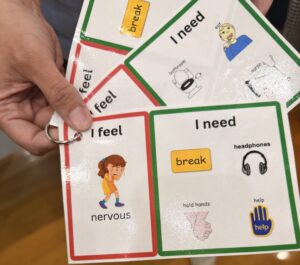

A learner who recognizes they’re nervous can learn to ask for:
- headphones
- help
- someone to hold their hand
- a break
Now the learner isn’t just labeling an emotion, they’re using communication to change their environment in a way that supports their success.
That’s functional communication.
Building Self-Advocacy
One of the most valuable skills we can teach isn’t simply recognizing emotions; it’s learning what helps.
Over time, learners begin to make important connections:
“When I feel overwhelmed, headphones help.”
“When I feel tired, I can ask for a break.”
“When I’m worried, I can ask for help.”
Those are self-advocacy skills that extend far beyond the classroom.
Instead of relying on adults to interpret behavior or guess what a learner needs, we’re giving learners the tools to recognize their own internal state and communicate an effective solution.
A Helpful Reminder for Educators
I also appreciate that these visuals serve as a reminder for teachers, therapists, and caregivers.
When a learner communicates an emotion, our role isn’t simply to acknowledge it.
It’s to help them answer the next question:
“What would help right now?”
That shift changes our focus from celebrating identification to teaching independence.

Because the ultimate goal isn’t for a learner to say:
“I’m nervous.”
The goal is for them to say:
“I’m nervous. I need my headphones.”
Or:
“I’m tired. I need a break.”
That’s communication with a purpose.
And when learners can identify how they feel and communicate what they need, we’re doing much more than teaching emotional vocabulary, we’re teaching self-awareness, self-advocacy, and the functional communication skills that help them participate more successfully in everyday life.
Written by,
Louise Maggs, Pyramid UK Clinical Director
Based on a real Pyramid consultation, this article was prepared with AI assistance and reviewed by Pyramid staff for accuracy.
Visual supports created by Ryan Crosby, a teacher at the Sussex Consortium in Lewes, Delaware, to help learners connect emotional awareness with functional communication and self-advocacy.
Resources: